
Table of Contents
- Why Industrial Web Design Is Different From Standard Business Sites
- Industrial Website Design Best Practices That Actually Work
- The Benefits of Custom Web Design for Industrial Firms
- How to Showcase Industrial Projects Online
- What Industrial Websites Cost and How to Budget
- Working With a Small Design Team vs a Large Agency
- Conclusion: Getting Industrial Web Design Right
- Frequently Asked Questions
Last Updated: October 4, 2026
Why Industrial Web Design Is Different From Standard Business Sites
Industrial web design is the practice of building websites for manufacturers, fabricators, engineering firms and trades suppliers around the way procurement teams and engineers actually buy. At Creative Canary, we build these sites for Fremantle and Perth industrial clients, and the brief is always the same: prove capability fast, then make the next step obvious.
The market is bigger than most people assume. IBISWorld’s 2026 industry analysis of web design services counts 3,581 web design businesses operating nationally, growing at a 3.6% compound annual rate between 2021 and 2026.
So why do so many industrial sites still look like a brochure from 2014?
Because the audience is different. A homeowner browsing a café site wants atmosphere. A procurement manager checking whether you can hold tolerance on a 40-tonne fabrication wants evidence.
Below, we break down what actually works, what it costs to budget for, and how to choose who builds it.
Industrial Website Design Best Practices That Actually Work
The best industrial website design best practices all serve one goal: let a technical buyer verify you in under two minutes. Everything else is decoration.
Start with capability, not history. Engineers scan for materials, tolerances, capacity and certifications before they read a single paragraph of your story. Put those in a scannable block near the top, not buried three clicks deep.
Then handle the practical layer:
- Mobile-responsive design so a site supervisor can check your specs from a phone on the factory floor
- Fast load times, because slow pages lose technical visitors who are comparing four suppliers at once
- Clear contact paths with a phone number and a quote request, not a generic contact form
- Technical documentation such as spec sheets, CAD references and certification copies
- Search engine optimization built into the structure from day one
What most guides miss is that industrial buyers rarely convert on the first visit. They bookmark, forward your link to a colleague, and come back. Your site has to survive that gap without a salesperson standing next to it.
Mobile-Responsive Design and Technical Support
Mobile-responsive design means the site adapts cleanly to any screen size, and for industrial businesses it matters more than the desktop view. Site managers and estimators work from phones and tablets, often on poor signal in a shed or on a remote site.
That means large tap targets, readable spec tables that do not require pinch-zooming, and click-to-call phone numbers. Test on a real phone, not just a browser window resized to look narrow.
Technical support is the other half. A website is not a one-off delivery. Certifications expire, product lines change, staff move on. Ask any provider what happens after launch: who updates the spec sheets, who fixes a broken form, and how quickly. If the answer is vague, that is your answer.
The Benefits of Custom Web Design for Industrial Firms
The benefits of custom web design for industrial firms come down to fit. A template forces your capability into someone else’s structure. A custom build shapes the structure around how your buyers evaluate suppliers, and around the technical and compliance realities that generic agency sites never address.
Here is what custom actually unlocks that a theme cannot:
- Technical documentation handling. Spec sheets, tolerance tables, CAD references and certification copies need to be versioned, dated and easy to replace. A custom content structure lets you tag documents by standard, material or project type so an engineer can filter to exactly what they need.
- Compliance and safety presentation. Industrial buyers increasingly check accessibility and data handling before they shortlist. A custom build lets you meet the Web Content Accessibility Guidelines (WCAG) 2.2 at the AA level as a design requirement rather than a retrofit, and lets you state plainly how enquiry data is stored and who can access it, which matters when your buyers have their own procurement risk checks.
- Integration with the systems your office already runs. Most industrial firms run a CRM or ERP that holds the real record of a customer. A custom site can push a quote request or a document download into that system so your sales team sees who is engaging, not just who filled in a form.
- A project showcase that mirrors your tender process. Sector, scope, constraints, equipment, result. That structure is hard to force into a template’s blog layout.
There is a cost argument too. A template that needs heavy modification often ends up costing more in developer hours than a clean custom build, and you inherit limitations you cannot design your way out of. Off-the-shelf themes also carry the same layout as thousands of other sites, which is the opposite of standing out in a competitive tender shortlist.
One more benefit that rarely gets named: a custom build is easier to hand over. When the structure is documented and the components are named, the next person who touches the site, whether that is us or someone else, can find things. Template sites with twenty plugins stacked on top are the ones that become unmaintainable.
When you brief a designer, bring three real enquiries you have received. A good industrial site is built backwards from the questions buyers actually ask, not forwards from what looks impressive in a portfolio.
How to Showcase Industrial Projects Online
Showcasing industrial projects online works best when each project is presented as a short case study with a problem, a specification and a measurable outcome. Photos alone do not convince a procurement team. Evidence does.
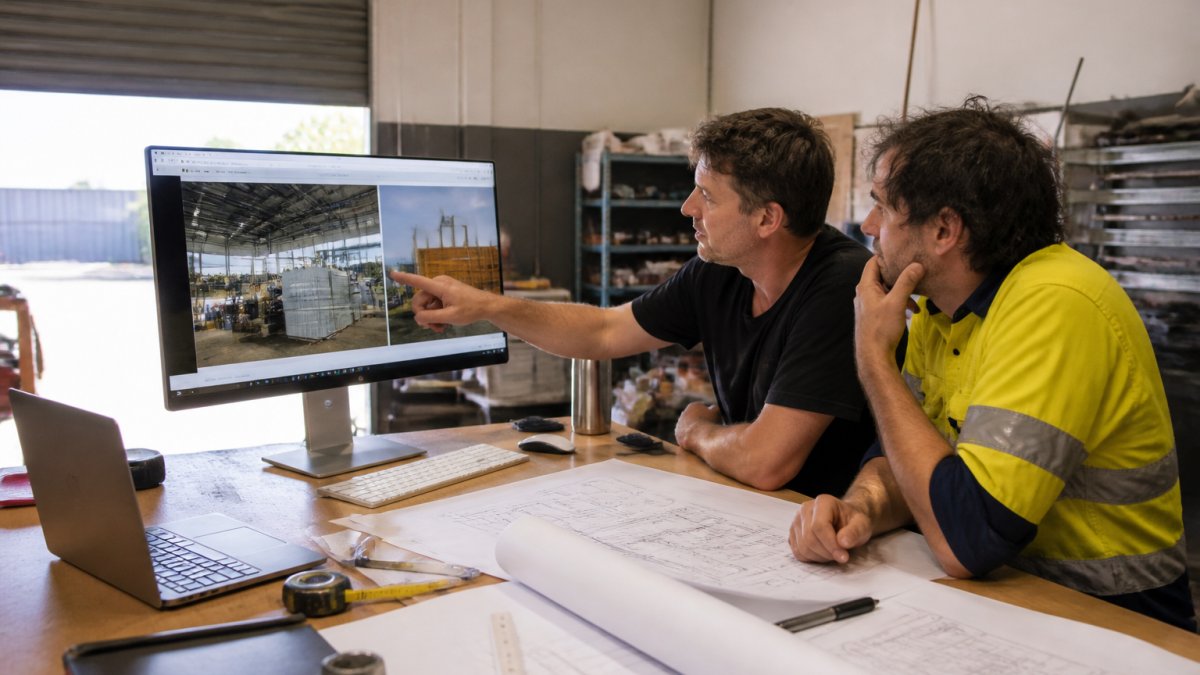
Give each project its own page with a consistent structure: the client’s sector, the scope, the constraints, the equipment used, and the result. Where you can, include numbers. Tonnage, lead time, tolerance, project duration. Specifics read as proof; adjectives read as marketing.
This is also where the biggest gap in the market sits. Most industrial sites in the competitive landscape stop at a photo gallery. Very few document compliance and safety standards alongside the work itself, and fewer still connect a project page to the CRM or ERP record behind it so the sales team knows who has been reading.
What Industrial Websites Cost and How to Budget
Pricing for industrial web design depends on scope, so treat any flat figure you see online with suspicion. The honest answer is that cost tracks the number of page templates, the depth of the project showcase, how much technical documentation needs structuring, and how much integration you need.
For context on the wider market, Wingify’s 2026 web design statistics estimates basic professional website design at roughly $6,500 to $15,000, with about 42% of design work now handled in-house rather than by external providers. That range covers simple sites, not a full industrial build with project case studies, document libraries and system integration.
Budget in four parts, not three:
| Budget area | What it covers | Ongoing? |
|---|---|---|
| Build | Design, development, content structure, launch | One-off |
| Integration | CRM or ERP connection, quote forms, document libraries | Usually one-off |
| Care | Hosting, security, updates, content changes | Recurring |
| Measurement | Analytics setup, enquiry tracking, reporting | Recurring |
The mistake we see most often is under-budgeting the third row. A site that nobody maintains quietly rots, and a stale certification page does real commercial damage.
The fourth row is where most industrial firms leave money on the table. A website is not a cost centre; it is a lead source, and you cannot manage what you do not measure. Before you approve a build, decide what you will track:
- Qualified enquiries per month, not total form fills, but the ones that match your ideal project size and sector.
- Cost per qualified enquiry, your total annual website spend divided by that number. This is the figure that lets you compare a website against a trade show stand or a print campaign.
- Enquiry-to-quote rate, how many qualified enquiries turn into a quoted job. If this is low, the problem is usually the site’s proof, not its traffic.
- Time on technical pages, spec sheets, project case studies and certification pages. Long dwell here is a strong signal of a serious buyer.
A common pattern is that industrial sales cycles run for months, with multiple people inside the buying organisation touching the site before anyone makes contact. That means the website’s job is not to close the sale.
Do not approve a fixed quote that lists no assumptions. If a provider will not state what is included in revisions and what triggers extra cost, you have no way to control the final invoice.
Working With a Small Design Team vs a Large Agency
A small design team usually means you talk directly to the person doing the work. That is the whole difference, and for industrial projects it matters more than brand prestige.
Large agencies carry overheads that get built into your quote: layers of management, lengthy onboarding phases, and a rotating cast on your account. You brief one person, they brief another, and by the time the work starts the original context is diluted. Some businesses find that this structure does not deliver the hands-on, tailored result a specialised industrial project needs.
We are two people. Philip handles graphic design, Anthony handles web design. You contact us, we discuss the project and your requirements, we quote, and we start. No layers between you and the work, and no handoff to someone who has never read your brief.
That model suits industrial clients particularly well, because the technical detail matters and it is easy to lose in translation. It also means the person who designed your site is the person who answers when something needs changing.
The right question is not “how big is the agency” but “who is actually doing the work, and can I speak to them directly”. Ask it before you sign anything.
Conclusion: Getting Industrial Web Design Right
The hard part of industrial web design is not the design. It is resisting the urge to build a site that impresses other designers instead of one that convinces a procurement manager to shortlist you.
Creative Canary is a Fremantle studio built for exactly this. We work so you deal directly with the people doing the work, and we keep our overheads low so the quote reflects the project rather than the office. Ten years in, with a 5/5 rating on Google Reviews, we have built sites and brand identities for clients across construction, hospitality, retail and non-profit work, including Valve & Fitting and Terra Mare.
If your current site undersells what you can actually build, let’s chat about what a proper industrial site would look like for your business.
Frequently Asked Questions
What features should an industrial business website include?
An industrial website needs technical specification pages, certification details, project case studies, and clear contact paths for procurement teams and engineers. Add search engine optimization so the right buyers find you, and a content management system so your team can update capabilities without a developer. Fireart Studio’s 2026 research found 75% of users judge a company’s credibility on website design alone, so every page should build trust with technical buyers.
How does professional web design improve industrial lead generation?
Industrial buyers are technical. Procurement teams check operational reliability while engineers look for production capabilities and certifications. A site built around conversion-focused design, with clear technical data and strong calls to action, moves those visitors toward an enquiry. Australian SMEs increased website and UX spending by 22-28% between 2025 and 2026, according to Melbourne Web Digital, because that investment feeds directly into lead generation.
Why is local expertise important for industrial web design?
Local designers understand the specific compliance and safety standards your industrial site must reflect, and they can meet you on site to see how your operation actually works. There are 3,581 web design businesses in Australia according to IBISWorld’s 2026 analysis, but few specialise in industrial work. Working with a local team means faster communication, in-person project discussions, and a site that speaks to the buyers in your region.
How does human-led design outperform AI for industrial branding?
AI can generate layouts, but it cannot sit in your workshop, understand how your team works, or judge which certification matters most to a procurement officer. Human designers ask questions, interpret technical requirements, and make creative decisions that AI tools miss. For industrial firms, that human judgement is what turns a generic template into a website that wins contracts.